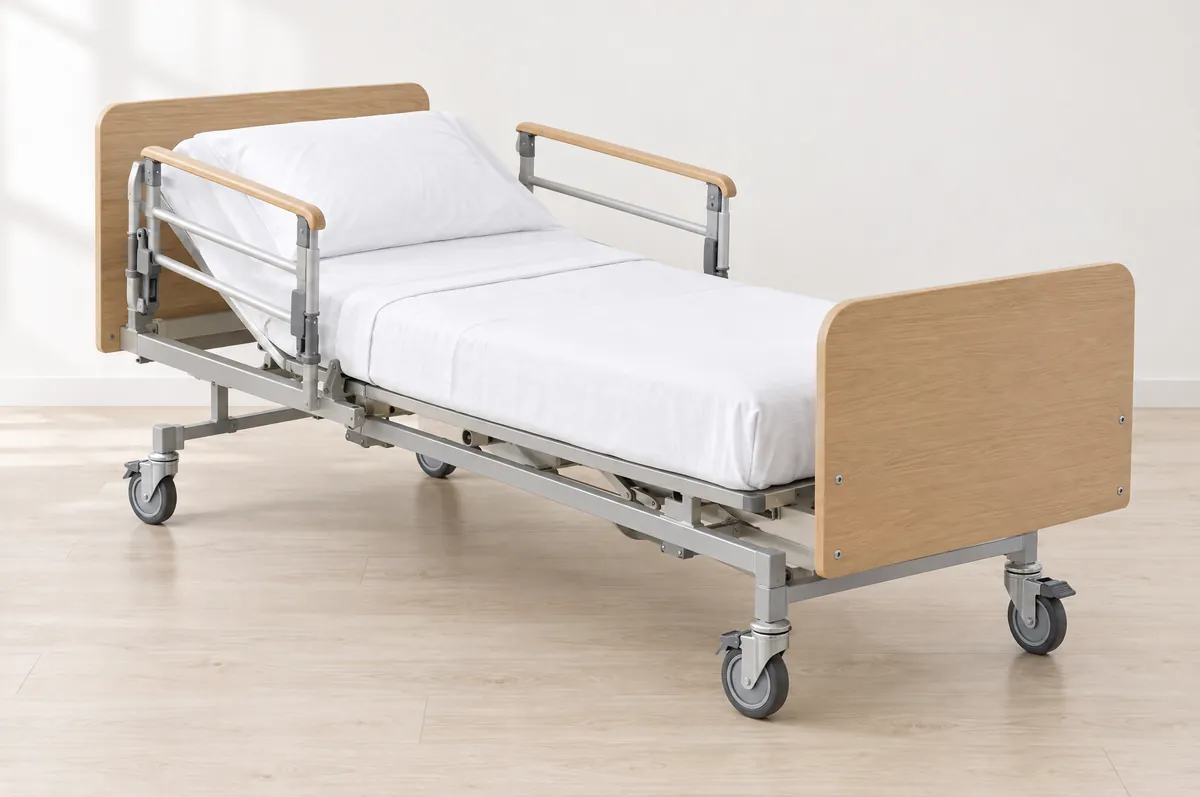
Bed rails are one of the most requested hospital bed accessories at home—and one of the most important safety decisions. This guide explains how hospital-system rails differ from adult portable rails, the main types you’ll see, entrapment risk at a high level, who the FDA says is at higher risk, how to check fit, and safer alternatives. It’s general information; the care team should decide whether rails are appropriate for the person.
Hospital bed rails vs adult portable rails
Hospital bed rails (sometimes called side rails) are usually designed to attach to a medical / hospital-style bed frame as part of a system with a matching mattress and deck.
Adult portable bed rails are products marketed for use with many home beds. The FDA publishes consumer recommendations specifically for portable rails and warns that not all rails, mattresses, and frames are interchangeable (FDA; FDA portable rail hub).
If you have a hospital-style bed, prefer rails made for that bed. Don’t assume a portable rail from a drugstore aisle will fit safely. If the person sleeps in a regular bed, our guide to bed rails for the elderly covers assist handles, portable rails, the federal safety standard, and recall checks.
Types of rails you’ll see
| Type | What it’s like | Common reason families choose it | Gaps to watch |
|---|---|---|---|
| Full-length rails | Run most of the side of the bed | Keeps more of the side enclosed | Openings within the rail; gaps at mattress edge |
| Half-length / assist rails | Shorter rail, often near the head | Help for sitting up or rolling to the edge | Larger open space toward the foot; still check rail openings |
| Split rails | Separate head and foot sections | Leaves a gap for getting in and out mid-bed | The gap between the two rail sections |
None of these is automatically safer. Fit to the mattress and frame, and the person’s ability to climb or become trapped, matter more than the marketing name.
Entrapment risk (high level)
Entrapment is when a person is caught, trapped, or entangled in the spaces in or around the rail, mattress, or bed frame. Between January 1, 1985, and January 1, 2013, the FDA received 901 reports of patients caught, trapped, entangled, or strangled in hospital beds, including 531 deaths, 151 nonfatal injuries, and 220 near-misses; most patients were frail, elderly, or confused (FDA).
FDA guidance describes several areas (often summarized as seven zones) where trapping can occur—within the rail, under the rail, between rail and mattress, near rail ends, between split rails, between rail end and head/foot board, and between mattress and board (FDA guide). Our hospital bed safety pillar summarizes those zones in a table.
Who is at higher risk?
The FDA lists people with conditions such as confusion, restlessness, or lack of muscle control as at high risk for entrapment, falls, or other injury from bed rails. So are people cognitively impaired by medication or a condition such as Alzheimer’s or dementia, Parkinson’s disease, multiple sclerosis, balance disorders, stroke, or low blood pressure (FDA). Rails should not replace monitoring for people at high risk.
Fit, mattress matching, and daily checks
Before rails go on—and regularly afterward:
- Confirm the person’s age, size, and weight suit the rails, following the maker’s instructions.
- Use a mattress made for that bed so edges don’t leave wide gaps; soft mattresses, air mattresses, and toppers can compress and create openings (FDA).
- Install retention straps or hardware exactly as directed; re-check after the bed is moved.
- Inspect for gaps with the head and foot raised and, if the bed changes height, at more than one height.
- Keep the bed low and the wheels locked when the person is in it.
Mattress choice is covered in hospital bed mattresses. A printable setup list is in our hospital bed checklist.
Safer alternatives when rails aren’t appropriate
When rails aren’t the right choice, the FDA lists alternatives such as roll guards, foam bumpers, lowering the bed as near to the floor as possible, concave mattresses that help reduce rolling off, and a trapeze to help reposition and get in and out of bed (FDA).
Practical pairings many care teams discuss:
- A low or hi-low bed so nighttime height is near the floor and daytime height supports safe transfers. See low hospital beds and hi-low hospital beds.
- Bedside fall mats to cushion a short drop—not to prevent the fall. See fall mats for the elderly.
- A bed-exit alarm so a caregiver knows when the person starts to get up. See bed alarms for the elderly.
- Clear floors, night lighting, and essentials within reach.
Make it a care-team decision
Ask the clinician or home health team: Is the goal repositioning help, fall prevention, or both? Does the person try to climb? Is confusion likely at night? Which alternatives fit the room and staffing? Bring photos of the bed, mattress, and any rails you already have.
Medicare may cover side rails when the person’s condition requires them and they are part of, or an accessory to, a covered bed (LCD L33820). Coverage doesn’t mean rails are clinically right for every person.
How we researched this guide
All safety facts come from FDA hospital bed, portable rail, and entrapment guidance pages, plus Medicare’s LCD L33820 for rail coverage framing, checked October 12, 2026. This isn’t medical advice.