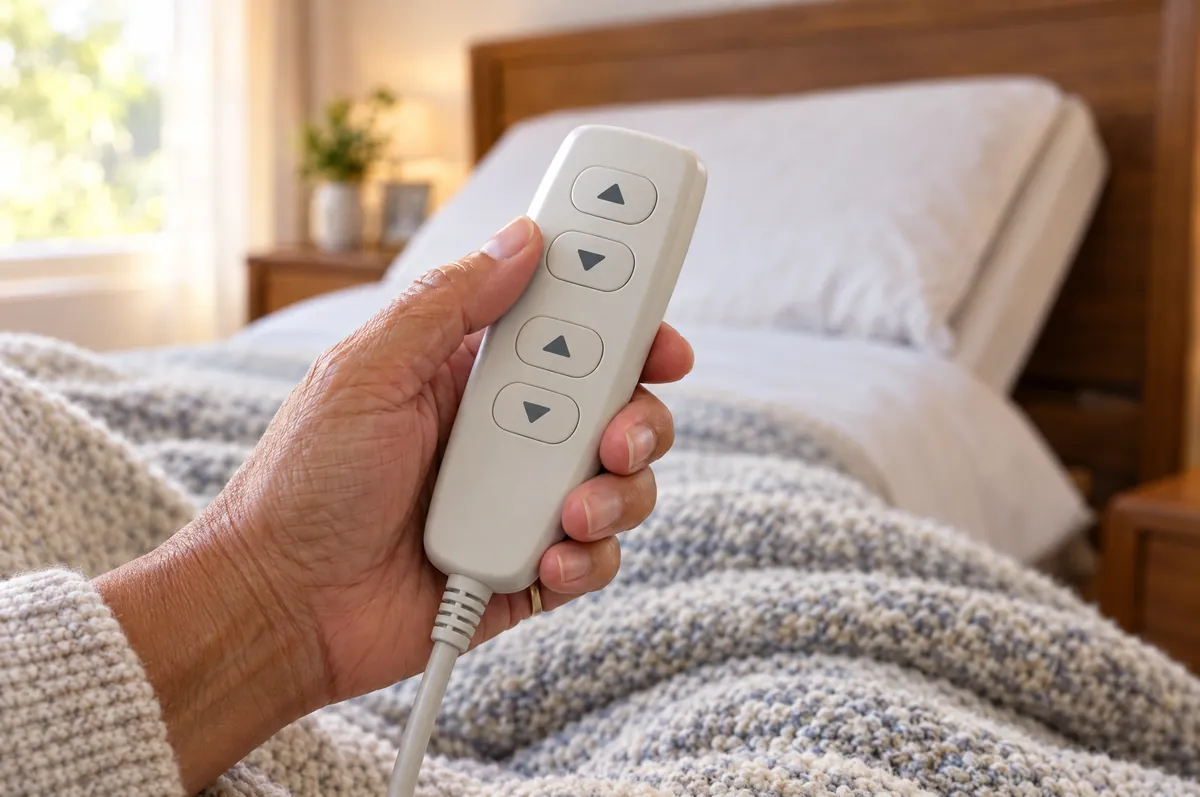
“Hi-low” (also written hi-lo or high-low) describes a bed whose entire frame rises and lowers on a motor. It’s separate from the head and knee adjustments that almost every hospital bed has. A good height range makes a bed safer for the person and easier for the caregiver. This guide explains why, how to read height specs without being misled, and how a dozen home beds compare on their published ranges, checked October 6–9, 2026. We haven’t tested these beds.
Why bed height matters: three heights to think about
A hi-low bed can go low for sleeping (to shorten a fall), to sitting height for getting up, and high for caregiving, all with a button.
- Low, for sleeping. A bed close to the floor shortens the distance if someone rolls out. The FDA lists lowering the bed as near to the floor as possible among the alternatives to consider when bed rails aren’t appropriate (FDA).
- Sitting height, for getting up. A common starting point is a height where the person sits on the edge with feet flat on the floor and knees at about a right angle. A therapist can fine-tune it.
- High, for caregiving. Raising the bed lets a caregiver wash, dress, or reposition the person without bending, which protects their back.
A hi-low bed covers all three with a button. A semi-electric bed changes height with a hand crank, so in practice it’s often left at one height.
Hi-low hospital bed vs hi-low adjustable bed
Hi-low hospital beds are usually single-width, FDA-regulated medical devices with hospital rails and often Trendelenburg; hi-low adjustable beds come in regular sizes up to queen and split king with a residential look but fewer clinical features.
| Hi-low hospital bed | Hi-low adjustable bed | |
|---|---|---|
| Examples | Drive Delta low bed and P903, Med-Mizer SelectCare and AllCare, SonderCare Aura, Prius Ai1 | Flexabed Hi-Low SL, Dawn House Bed, Transfer Master Supernal, Golden Passport |
| Sizes | Mostly single (36–42 in.), bariatric to 48–54 in. | Twin to queen and split king |
| Clinical features | Hospital rails; Trendelenburg on many; hospital mattress systems | Varies; few have Trendelenburg (Transfer Master Supernal 5 does) |
| Regulation | Powered hospital beds are FDA-regulated medical devices (21 CFR 880.5100) | Usually sold as adjustable beds |
| Look | Clinical to furniture-style | Residential |
Hi-low ranges compared
Published deck heights for home hi-low beds run from 3.6 inches (Med-Mizer AllCare) at the low end to 32 inches (SonderCare Aura) at the high end. Makers measure differently, so check how each figure is measured.
| Bed | Published height range | How it’s measured | Weight limit |
|---|---|---|---|
| Med-Mizer AllCare | 3.6–25 in. (or 8.5–30) | Deck | 600 lb |
| Drive Prime Care P903 | 7–30 in. | Deck | 600 lb |
| Drive Delta Ultra-Light 1000 low bed | 9.25–23 in. | Deck | 450 lb total |
| Med-Mizer SelectCare | 10–25 in. | Deck | 600 lb |
| SonderCare Aura | 10–32 in. (17–39 in. to top of mattress) | Deck | 500 lb |
| Prius Ai1 | 10–31 in. | Per maker | 600 lb safe working load |
| Dawn House Bed | 10–16 in. | Base, no legs or mattress | 750 lb, evenly distributed |
| Transfer Master Supernal 3 | 10.5–20.5 in. | Deck to floor | 400–500 lb |
| Golden Passport | 10.5–28 in. | Deck, with all leg extensions for the top height | Not stated |
| Transfer Master Supernal 5 | 12–24 in. | Deck to floor | 400–500 lb |
| Med-Mizer ActiveCare Standard | 12.5–27.5 in. | Deck | 600 lb |
| Flexabed Hi-Low SL | About 16.5–24 in. | Top of a low-profile mattress, on leg pads | 400 lb single occupant |
From each maker’s website or manual, checked October 6–9, 2026. Not a ranking. Add the mattress thickness to deck heights to get the sleeping height.
How to read height specs
Check whether a height is measured to the deck or the top of the mattress, whether it includes casters or legs, and whether the bed moves toward the foot as it rises.
- Deck vs top of mattress. A 10-inch deck with a 7-inch mattress puts the person at about 17 inches. SonderCare, for example, publishes both figures.
- Casters and legs. Casters or add-on legs raise the whole range. Golden reaches 28 inches only with all its leg extensions.
- Travel. Some hi-low beds move toward the foot as they rise (Flexabed’s Hi-Low SL travels 7.5 inches), so leave room.
- Range vs minimum. For fall risk, the low number matters most; for caregiving, the high number does.
Who needs a hi-low bed
A hi-low bed suits someone at risk of falling out of bed, someone who needs the bed at the right sitting height to stand, or a household where a caregiver gives hands-on care every day.
- Someone at risk of rolling or slipping out of bed, who benefits from a low sleeping height. See low beds for fall risk and fall mats.
- Someone who can stand with help but needs the bed at the right sitting height to do it.
- A household where a caregiver provides hands-on care every day.
If the person is mostly independent and only needs the head raised, a semi-electric bed or a regular adjustable bed may be enough. See semi-electric vs full-electric.
Medicare and hi-low beds
Medicare usually doesn’t cover hi-low beds, because powered height makes them total electric beds, which its policy treats as a convenience.
Medicare can cover fixed-height, variable-height (manual crank), and semi-electric hospital beds when coverage criteria are met, but its policy says a total electric bed is not covered because height adjustment is a convenience feature (LCD L33820). A hi-low bed is usually a private purchase, or an upgrade you pay for on top of a covered bed. See does Medicare cover hospital beds?
Where to start
Start with Drive for a lower-cost clinical hi-low bed, Med-Mizer, SonderCare, or Transfer Master for a furniture look, Flexabed or Dawn House for regular-bed sizes, and the Prius Ai1 or a bariatric bed for larger people.
- Basic clinical hi-low, lower cost: Drive’s Delta low bed or P903. See our Drive guide.
- Hi-low with a furniture look: Med-Mizer SelectCare, SonderCare Aura, or Transfer Master Supernal 5. See hospital beds that look like regular furniture.
- Hi-low in a regular-bed size for couples: Flexabed Hi-Low SL or Dawn House Bed. See queen and full-size beds.
- Hi-low for larger people: Prius Ai1 or a bariatric bed. See our bariatric bed guide.
Drive Delta low bed (opens in a new tab)Paid link · Retailer shares ownership with this site · Drive P903 (opens in a new tab)Paid link · Retailer shares ownership with this site · Transfer Master Supernal 5 (opens in a new tab)Paid link · Retailer shares ownership with this site · Flexabed Hi-Low SL (opens in a new tab)Paid link · Retailer shares ownership with this site · Dawn House Bed (opens in a new tab)Paid link · Retailer shares ownership with this site · Prius Ai1 (opens in a new tab)Paid link · Retailer shares ownership with this site
Not sure what range you need? Take the bed finder quiz, or request a quote.
How we researched this guide
Height ranges and weight limits come from each maker’s own website, spec sheet, or manual, checked October 6–9, 2026. Coverage rules come from CMS, and safety guidance from the FDA. We haven’t tested these beds, the table isn’t a ranking, and no maker paid for or reviewed this page. See how we evaluate beds.