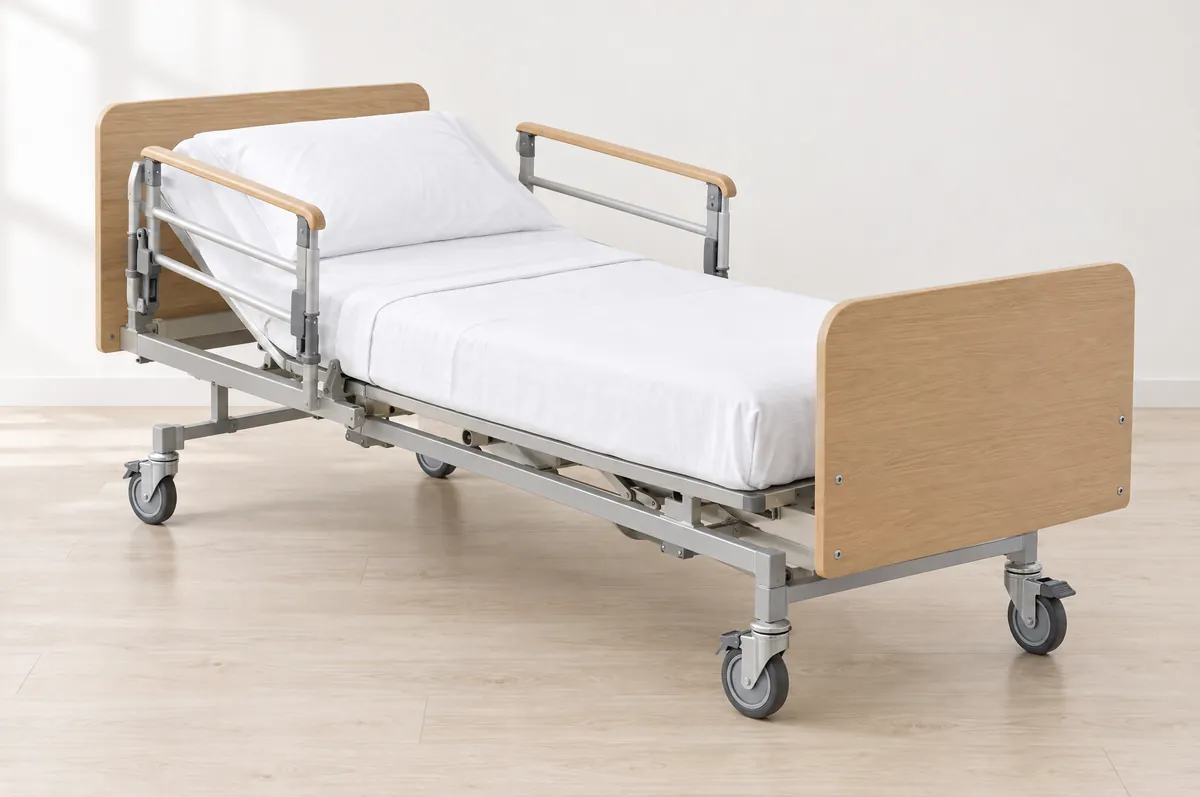
When someone might roll, slip, or climb out of bed, families often look first at rails. A low bed is another option, and for some people it’s the safer one. This guide explains how low and hi-low beds work, compares real models on their published heights and weight ratings, and covers the extra challenge of finding a low bed for a larger person. It’s general information; the care team should guide fall-prevention decisions.
Why bed height matters for falls
A bed that goes close to the floor shortens the distance if someone ends up out of bed. The FDA lists “lowering the bed as near to the floor as possible” among the alternatives to consider when bed rails aren’t appropriate, alongside roll guards, foam bumpers, concave mattresses, and a bed trapeze. It also warns that some people are at higher risk of entrapment and falls with rails, including people with confusion, restlessness, or poor muscle control, and that rails shouldn’t be used in place of proper monitoring (FDA). Our hospital bed rails guide covers entrapment risk and rail types in more detail.
A low position isn’t the whole answer, though. It’s hard to stand up from a very low surface, and a caregiver can’t work at floor level. That’s why most low beds are hi-low beds: low for resting and sleeping, raised to a comfortable height for standing up, transfers, and care.
Low vs hi-low vs standard: the numbers that matter
Compare four numbers: the lowest deck height, the top-of-mattress height, the highest deck height, and the weight rating. For reference, a standard Drive home bed goes down to 12.75 inches without casters.
- Lowest deck height: how close the platform gets to the floor. This is what makers usually quote.
- Top-of-mattress height: add the mattress thickness, often 6 inches for foam and 8 to 10 inches for powered air. This is where the person actually lies.
- Highest deck height: what a caregiver works at. Around 25 to 31 inches is common on hi-low beds.
- Weight rating: low beds don’t all carry the same load, and the very lowest models we found top out at about 600 lb.
For reference, Drive’s standard Delta Ultra-Light 1000 home bed lists a 12.75-inch minimum height without casters.
Low and hi-low beds compared on published specs
The lowest bed we found is the Med-Mizer AllCare (3.6 inches); the lowest published price is the Med-Mizer RetractaBed ($2,250, down to 9 inches). Our Med-Mizer guide compares every model in that line.
| Bed | Lowest–highest deck height | Widths | Weight rating (as published) | Price (published) |
|---|---|---|---|---|
| Med-Mizer AllCare | 3.6–25 in. (or 8.5–30 in.) | 35, 39, or 42 in. | 600 lb maximum SWL | $3,839 on Med-Mizer’s store |
| Drive Prime Care P903 | 7–30 in. | Expands 36–39–42 in.; 80, 84, or 88 in. long | 600 lb | Check current pricing |
| Prius Ai1 | 10–31 in. | Expands 35–42–48 in.; 80–88 in. long | 550 lb patient; 600 lb SWL | Listed at $11,950 by several online retailers |
| Med-Mizer SelectCare | 10–25 in. | 36, 39, or 42 in. | 600 lb maximum SWL | $5,887 on Med-Mizer’s store |
| Dawn House Bed (base) | 10–16 in., without legs or mattress | Twin Long to Split King | 750 lb evenly distributed | Base from $3,499 (twin long, on sale Oct 9) |
| Transfer Master Supernal 3 Hi-Low | 10.5–20.5 in. | Twin, Full, Queen, Dual King | 400 lb (Twin); 500 lb (Full, Queen) | Starting at $3,999 |
| Med-Mizer RetractaBed | 9–25 in. | 35, 39, or 42 in. (expandable) | 500 lb (600 lb option) | $2,250 on Med-Mizer’s store |
| Med-Mizer ComfortWide CW1000 | 12–28 in. | Expands 36–42–48 in. | 1,000 lb patient; 1,150 lb SWL | $6,785 on Med-Mizer’s store |
| Transfer Master Night Rider HD | 12–24 in. | Twin, Full, Queen, Dual King | 750 lb evenly distributed | Starting at $6,999 |
| Drive Lightweight Bariatric (48 and 54 in.) | About 15.7–24 in. | 48 or 54 in. | 750 / 1,000 lb SWL | About $3,150–$3,550 at online retailers |
Specs from makers’ product pages, spec sheets, and manuals; prices from the maker’s own store or site where published, otherwise from listings at online retailers. Checked October 9, 2026 (Dawn House and Supernal 3 prices checked October 6, 2026). SWL = safe working load. Prices change, so check current pricing.
What stands out
- Lowest overall: Med-Mizer’s AllCare, at 3.6 inches, with an optional safety mat from Med-Mizer.
- Lowest published price: Med-Mizer’s RetractaBed, at $2,250 on Med-Mizer’s store, goes down to 9 inches, and Med-Mizer says its sleep surface retracts toward the head to keep a nightstand within reach.
- Low and expandable, with monitoring built in: the Prius Ai1 pairs a 10-inch low height with a 48-inch maximum width, a built-in scale, and a three-zone bed-exit alarm that alerts caregivers. It’s the most fully equipped bed here, and the most expensive.
- Low with a residential look: the Med-Mizer SelectCare and the Dawn House base. Note that Dawn House is an adjustable base marketed as a hospital bed alternative, and its 10-inch figure is without a mattress or legs.
- Long-term care design: Drive’s P903 reaches 7 inches with an expanding width and length; Trendelenburg is available with an optional staff control.
Low beds for larger patients
Choices narrow for larger patients: the lowest hospital beds we found (3.6 to 10 inches) are rated to about 600 lb, and heavier-rated beds don’t go as low. Among the beds we checked:
- Up to about 600 lb: the AllCare (3.6 inches), P903 (7 inches), Ai1 (10 inches, 550 lb patient limit), and SelectCare (10 inches) all go low, but only the Ai1 is wider than 42 inches.
- 750 lb and up: the lowest published deck heights rise to about 12 inches (Transfer Master Night Rider HD at 750 lb, and Med-Mizer’s ComfortWide CW1000 at 1,000 lb with a 48-inch expanding deck) and about 15.7 inches (Drive’s 48- and 54-inch lightweight bariatric beds).
So if someone needs both a very low height and a rating above 600 lb, ask makers and suppliers directly; you may need to weigh one against the other with the care team. Our bariatric bed guide and bariatric sizes and weight limits cover the capacity side in detail.
Compare bariatric and low bariatric beds (opens in a new tab)Paid link · Retailer shares ownership with this siteWhat else is used with low beds
Low beds are often paired with floor mats, bed-exit alarms, night lighting, and assist bars or a trapeze.
- Floor mats beside the bed soften the landing if someone rolls out. Med-Mizer offers a safety mat for the AllCare. Mats can be a trip hazard for anyone walking, including caregivers, so plan when they’re down. Our fall mats guide compares mat types and sizes.
- Bed-exit alarms alert a caregiver when the person starts to get up. The Prius Ai1 has one built in; standalone alarms also exist. See bed alarms for the elderly for the types and how to set one up.
- Under-bed or night lighting helps someone see the floor at night. Several beds offer it, including the AllCare, SelectCare, and P903.
- Assist bars or a trapeze can help with repositioning and getting up, as the care team advises. The FDA lists a bed trapeze among alternatives to rails.
- Rails, if used, must be made for the bed and checked for gaps. See hospital bed safety.
A simple routine for low beds
- Resting or sleeping: bed at its lowest, wheels locked, mat down if used.
- Before standing up: move the mat out of the way and raise the bed to the sitting height the care team or therapist recommends, usually one where the person’s feet rest flat on the floor.
- During care: raise the bed to a comfortable working height for the caregiver.
- Afterward: lower the bed again.
Ask the care team or a therapist to set heights that suit the person. If a patient lift will be used, check the under-bed clearance at the height you’ll use it.
What Medicare covers
Medicare doesn’t have a separate code for low beds: it covers hospital beds by how they adjust and by weight capacity, and it treats powered height as a convenience, so most hi-low beds are private purchases.
Medicare’s hospital bed codes are defined by how the bed adjusts (fixed height, variable height, semi-electric, total electric) and by weight capacity (heavy duty), not by how low the bed goes (CMS policy article A52508). It treats powered height adjustment as a convenience feature and doesn’t cover total electric beds (LCD L33820). In practice, many low hi-low beds are bought privately or supplied as a paid upgrade. See semi-electric vs full-electric beds and our Medicare guide.
Next: take the bed finder quiz, compare furniture-style hi-low beds, or request a quote for a low bed in the width and rating you need.
How we researched this guide
Heights, widths, and ratings come from makers’ product pages, spec sheets, and manuals (Med-Mizer, Drive, Prius Healthcare, Dawn House, Transfer Master), checked October 6–9, 2026. Fall and rail guidance comes from the FDA, and coverage rules from CMS. We did not test these beds, and the table order is not a ranking. See how we evaluate beds.