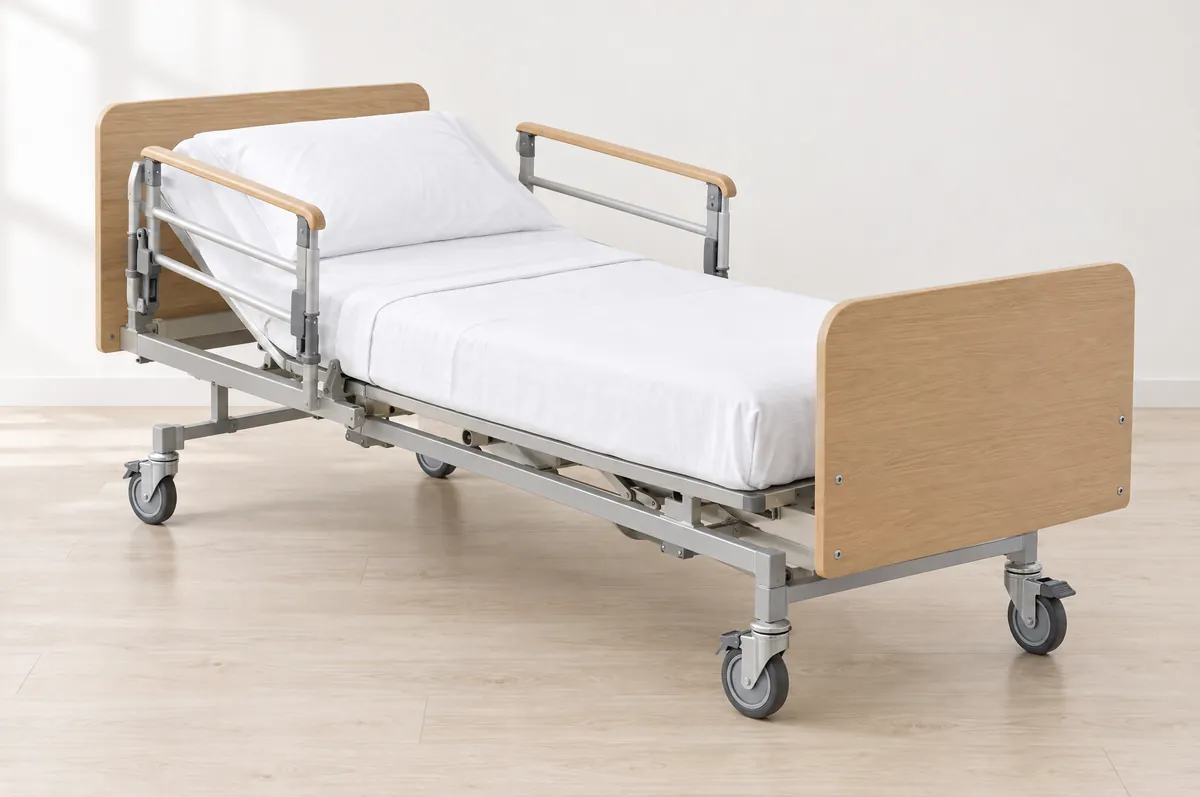
Falls are common in later life. More than one in four people aged 65 and older fall each year, and about 37% of those who fall report an injury that needed treatment or limited their activity for at least a day, according to the CDC (CDC). When a person might roll or slip out of bed, a bedside fall mat is one of the simplest things families add. This guide explains what fall mats do and don’t do, the main types, how to choose one, and how to use it alongside a low bed without creating a new trip hazard. It’s general information; the care team should guide fall-prevention decisions.
What a fall mat does, and what it doesn’t
A fall mat is a firm foam pad, usually with a wipe-clean cover, that lies on the floor beside the bed. If the person ends up out of bed, it cushions the landing compared with a hard floor. It doesn’t prevent the fall, and it doesn’t replace supervision, a safe bed height, or the care team’s plan.
It works best with a low bed. A bed that goes close to the floor shortens the drop, and the mat softens what’s left. The FDA lists lowering the bed as near to the floor as possible among the alternatives to consider when bed rails aren’t appropriate (FDA). See our low beds for fall risk guide.
Types of bedside fall mats
The main types are tri-fold foam mats, low-profile beveled mats, bi-fold mats, and safety mats sold to match a specific bed.
| Type | What it’s like | Good for | Watch out for | Example (published size) |
|---|---|---|---|---|
| Tri-fold foam mat | Thicker foam in three hinged sections; folds for storage | Nights when the person stays in bed; easy to fold away by day | Thicker edge is more of a trip hazard | Drive Tri-Fold Bedside Fall Mat: 72 × 30 × 2 in., vinyl cover, non-skid bottom |
| Low-profile beveled mat | Thinner mat with tapered edges | People who sometimes walk; rooms where an overbed table or lift needs to roll over it | Less cushioning than thicker mats | Drive PrimeMat 2.0: 72 in. long, tapered edges, non-slip top, anti-slip bottom netting |
| Bi-fold mat | Folds in half for storage | Moving between rooms or storing under the bed | Check thickness and cover | Several makers offer bi-fold versions |
| Bed-specific safety mat | Sold by the bed’s maker to match it | Floor-level beds | Fit only to that bed | Med-Mizer offers a safety mat for its AllCare low bed |
Sizes and features of named products from Drive’s and Med-Mizer’s websites, checked October 9, 2026. Drive says its PrimeMat 2.0’s tapered edges let equipment such as overbed tables or patient lifts roll over it.
How to choose a fall mat
Choose a mat that covers the side the person gets out of, with a thickness and edge that suit whether anyone walks on it, a wipe-clean cover, and a non-slip base.
- Length: cover the side of the bed the person gets out of or could roll from. Many mats are 72 inches long; a standard hospital bed is 80.
- Thickness and edges: thicker mats cushion more but are harder to walk across. If the person or caregiver will step on it, look for a low profile and beveled edges.
- Cover: a wipe-clean, fluid-resistant cover (vinyl or similar) is easier to keep hygienic.
- Base: a non-slip bottom keeps the mat from sliding, especially on hard floors.
- Storage: folding mats are easier to move out of the way during the day.
- One side or two: if the bed is against a wall, one mat may do; otherwise you may need two.
Using a fall mat safely
Use the mat while the person is in bed, with the bed at its lowest and the wheels locked, and move it before they stand or before hands-on care.
- At night: bed at its lowest, wheels locked, mat down on the open side.
- Before the person stands: fold or slide the mat away, raise the bed to a safe sitting height, and make sure footwear and a walker are within reach.
- For caregivers: move the mat before hands-on care so you aren’t working on an unstable surface.
- Lighting: a night light or under-bed lighting helps everyone see the mat’s edge.
- Check the mat: replace it if the foam compresses or the cover cracks.
Our low beds guide has a fuller day-and-night routine.
What else helps
A low or hi-low bed, a bed-exit alarm, a rotating or sit-to-stand bed, and basic home fall-prevention steps work alongside a mat.
- A low or hi-low bed, so the bed is close to the floor at night and at a safe sitting height for getting up. See hi-low hospital beds. If you’re comparing rails instead of (or with) a mat, see hospital bed rails.
- Bed-exit alarms, which alert a caregiver when the person starts to get up. Ask the care team whether one suits the person; our bed alarms guide compares the types.
- A rotating or sit-to-stand bed for someone who struggles to get from lying to sitting. See rotating beds for the elderly.
- Home safety basics: the CDC lists clutter, throw rugs, poor footwear, and vision problems among fall risk factors (CDC).
Paying for a fall mat
Bedside fall mats are inexpensive compared with a bed, and families usually buy them privately. Listings we saw in October 2026 for Drive mats ran from about $99 to $227. Coverage is uncommon, so ask your plan or supplier before you buy.
Choosing a low bed to go with the mat? Take the bed finder quiz, or request a quote.
How we researched this guide
Mat sizes and features come from Drive Medical’s and Med-Mizer’s websites, and prices from public online listings, checked October 9, 2026. Fall statistics come from the CDC and rail guidance from the FDA. We haven’t tested these mats, we don’t publish ratings, and no maker paid for or reviewed this page. See how we evaluate beds.