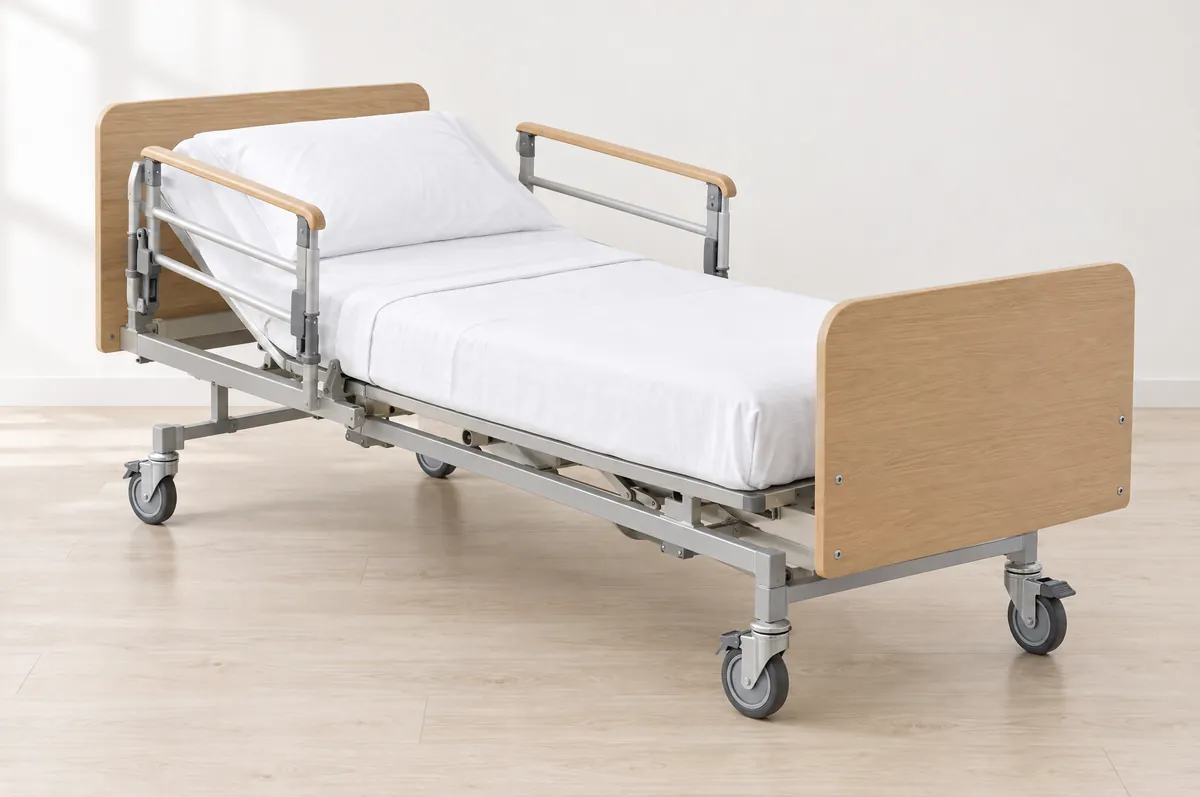
Most people searching for bed rails for an older parent are trying to solve one of three problems: they struggle to sit up and get out of bed, they might roll out at night, or the family wants to know when they get up. A bed rail is the right tool for only some of these, and the wrong rail on the wrong bed can trap a person. This guide helps you match the device to the need, explains the federal safety standard in plain English, and walks through fit checks you can do at home. It’s general information; ask the doctor, nurse, or therapist whether a rail suits the person.
Start with the problem you’re solving
| What’s happening | Device that usually fits | What to watch |
|---|---|---|
| Trouble pushing up to sit, turning over, or steadying to stand | Assist handle / bed cane: a short upright handle near the head of the bed | Smallest footprint, but it still creates gaps that must fit tightly |
| Rolling toward the edge in sleep | Longer portable side rail, or an alternative such as a low bed, roll guards, or foam bumpers | Longer rails leave more openings to check, and some people try to climb over |
| Getting up alone at night, especially with confusion | Often not a rail: a bed-exit alarm, a low bed, and a fall mat | The FDA lists confusion and dementia among the conditions that raise the risk with rails |
| Already has a hospital bed | Rails made for that bed | See hospital bed rails; portable rails for regular beds aren’t meant for medical beds |
If the honest answer is “they need help getting up and we’re worried about nights,” you may need two different things: an assist handle for the day and a separate plan for nights. Our guide to bed alarms for the elderly covers the night side.
Types of bed rails for regular beds
Assist handles (bed canes, bed handles). A short frame with a hand grip that stands up beside the mattress near the pillow. Most slide between the mattress and the box spring or platform and are held by a strap. They give something firm to push against when sitting up or standing. Because they’re short, they don’t do much to stop rolling.
Half-length portable rails. Longer rails that cover the upper part of the bed. Some fold down so the person can get in and out. They give more to hold onto and a partial barrier against rolling.
Full-length or extra-long rails. Run most of the side of the bed. They block more of the edge, but they also create the most openings to check and can tempt a determined person to climb over, which can make a fall from a greater height.
Floor-supported rails and transfer handles. Some designs rest on the floor beside the bed instead of relying only on the mattress to hold them. Whatever the design, the federal standard treats grab bars, assist bars, transfer aids, canes, and rails installed on, against, or next to an adult bed as adult portable bed rails.
The federal safety standard, in plain English
In 2023 the U.S. Consumer Product Safety Commission (CPSC) adopted a mandatory safety standard for adult portable bed rails, codified at 16 CFR part 1270. It applies to rails manufactured after August 21, 2023, and adopts the voluntary standard ASTM F3186-17 with CPSC changes. Among other things, a compliant rail must:
- Have a retention system (such as a strap) that is permanently attached and can’t be removed without a tool.
- Stand at least 4 inches above the top of the thickest mattress the maker recommends it for.
- Pass entrapment tests in four zones: within the rail, between the rail support and mattress, between the rail and mattress, and under the end of the rail.
- Be built so that if it’s put together wrong, it visibly doesn’t work.
- Carry permanent warning labels.
The standard doesn’t cover side rails meant for FDA-regulated hospital beds, which follow FDA guidance, or bed rails for children.
What this means for you: a rail made before the standard took effect, a second-hand rail with no labels, or a listing that can’t tell you the maker and model is a gamble. Ask the seller whether the rail is certified to 16 CFR part 1270, and keep the box label and manual.
Check for recalls before you use any rail
The CPSC says that from 2021 through late 2024 it announced nine recalls and safety warnings covering more than 3 million adult portable bed rails, associated with 18 deaths, and recalls have continued since. Separately, it identified 284 entrapment deaths involving adult portable bed rails from January 2003 to December 2021. The CPSC says the large majority of deaths and injuries involve entrapment of the head, neck, or chest.
Before using a rail, new or hand-me-down:
- Find the brand and model on the rail, the label, or the original listing.
- Search them on the CPSC recalls site.
- If the rail is recalled, stop using it and follow the recall instructions.
- If you can’t identify the rail at all, don’t use it for someone at risk.
If something goes wrong with a rail, you can report it to the CPSC at SaferProducts.gov.
Who is at higher risk with bed rails?
The FDA lists people with confusion, restlessness, or lack of muscle control as at high risk of entrapment, falls, or other injury from bed rails, along with people whose thinking is affected by medication or by conditions such as Alzheimer’s disease or other dementia, Parkinson’s disease, multiple sclerosis, balance disorders, stroke, or low blood pressure. See the FDA’s bed rail recommendations for consumers and caregivers.
These are often the very people families want rails for. That’s why the decision belongs with the care team, and why rails are never a substitute for checking on someone at high risk. Our hospital bed safety pillar explains entrapment in more detail.
How to install and check a bed rail at home
The CPSC and FDA safety tips come down to fit and follow-through. Use this checklist when you install the rail and again every few days:
- Compatible bed and mattress. The rail maker lists the bed types and mattress thickness it fits. Measure your mattress, including any topper or pillow top.
- Pressed firmly against the mattress. There should be no gap between the rail and the side of the mattress. Push the mattress toward the rail and look again.
- Retention strap installed and tight exactly as the instructions show. Re-check after changing sheets or moving the bed.
- At least 12.5 inches between the rail and the headboard or footboard, so a head or body can’t be caught in that space.
- No furniture beside the rail. Keep nightstands and dressers away from it.
- Only one rail per area. Don’t install several rails next to each other.
- Not modified. No added padding, ties, or pieces from other products.
- No climbing. If the person tries to climb over, the rail may be making things worse. Tell the care team.
- Re-check after any change to the mattress, topper, or bed.
Mattresses matter. Soft mattresses, air mattresses, and toppers compress and can open a gap between the rail and the mattress, and a thick topper can leave a rail too low to do its job. If you add a topper, re-check fit. Our hospital bed mattress guide explains why matching parts matter.
Adjustable and hospital beds. Rails for regular beds aren’t designed for beds that bend or change height. Use only a rail the maker says works with your bed. If you’re weighing a powered bed, our hospital bed vs adjustable bed comparison covers rails and other differences.
Alternatives when a rail isn’t the right fit
When rails aren’t appropriate, the FDA lists roll guards, foam bumpers, lowering the bed as near to the floor as possible, concave mattresses that help reduce rolling off, and a trapeze to help reposition and get in and out of bed. Other common pieces of a plan:
- A low or hi-low bed. A lower sleeping height shortens any fall. See low hospital beds and hi-low hospital beds.
- A bedside fall mat to cushion a short drop. It doesn’t prevent falls. See fall mats for the elderly.
- A bed-exit alarm so a caregiver knows when the person starts to get up. See bed alarms.
- A rotating or sit-to-stand bed for someone who can’t get from lying to sitting on their own. See rotating beds for the elderly.
- Night lights, a clear path to the bathroom, and essentials within reach, so the person isn’t reaching or wandering in the dark.
When a hospital bed may be the better answer
If a parent can’t sit up without help, needs the head of the bed raised, or the caregiver is doing hands-on care several times a day, a rail on a regular bed may be patching a bigger need. A home hospital bed raises the head and knees, and many models raise and lower the whole bed for safer transfers and lower nights. Rails for a hospital bed should be the ones made for it. Medicare’s hospital bed policy covers side rails when the person’s condition requires them and they’re part of, or an accessory to, a covered bed; a rail for your own bed is usually a private purchase. See does Medicare cover hospital beds.
Questions to ask the care team
- Is the main goal help getting up, keeping them from rolling out, or knowing when they get up?
- Would an assist handle alone be enough, or is a longer rail needed?
- Given their memory, medicines, and night-time behavior, is a rail likely to help or to add risk?
- Would a low bed, fall mat, or bed alarm be safer?
- Can a therapist show us how to get in and out of bed safely with whatever we choose?
Keep a copy of our printable hospital bed checklist by the bed if you move on to a hospital bed. It includes rail and gap checks.