
If you’re shopping for someone who needs more support in bed, you’ll quickly meet two kinds of beds that both “adjust.” They’re built for different jobs.
Hospital bed vs adjustable bed at a glance
| Hospital bed | Adjustable bed (consumer) | Hi-low furniture-style bed | |
|---|---|---|---|
| Head and foot adjust | Yes | Yes | Yes |
| Whole bed raises and lowers | Most do (crank or motor) | Usually no | Yes, powered |
| Rails | Designed for the bed | Usually none, or add-ons | Often optional, designed for the bed |
| Mattress | Usually 36 × 80 in., made to bend with the frame | Regular sizes | Often regular sizes |
| Regulated as a medical device | Yes, powered hospital beds (21 CFR 880.5100) | Generally sold as furniture | Varies by maker |
| Medicare | Covered for people who qualify (not full-electric) | Not covered | Usually not covered |
| Look | Clinical, though wood boards help | Residential | Residential |
| Built for | Care, transfers, repositioning | Comfort, reading, TV | Care in a residential design |
Medicare’s policy defines an ordinary bed as one “typically sold as furniture,” which “may or may not have head or leg elevation adjustments” (A52508).
Is an adjustable bed a hospital bed?
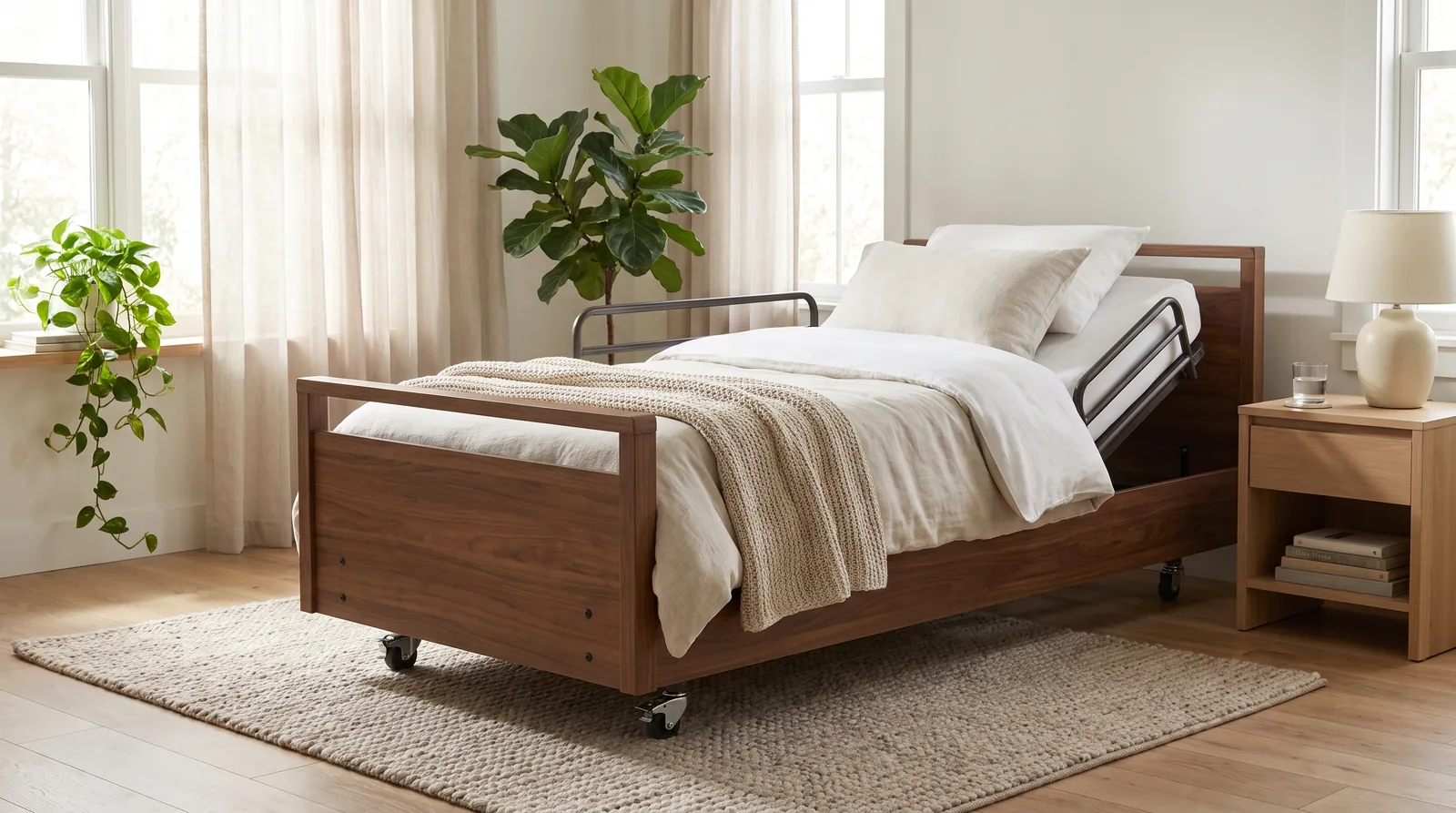
No. An adjustable bed is a comfort product: a powered base under a regular mattress that raises the head and feet. A hospital bed is built for care. Its height usually changes, so a caregiver can work at waist level and the person can get in and out at a safe height, and it takes rails and a mattress designed to work together.
When a hospital bed is the better choice
- The person needs help getting in and out of bed, or a different height to transfer.
- They need frequent repositioning, or must keep their head raised for long periods.
- A caregiver helps with care in bed, such as bathing, dressing, or changing sheets.
- There’s a risk of falling out of bed and the care team suggests a low bed.
- You want Medicare to help pay: it covers hospital beds for people who meet its criteria (LCD L33820).
When an adjustable bed may be enough
- The person gets in and out of bed independently and safely.
- The goal is comfort: reading, watching TV, or easing mild reflux or snoring with a raised head.
- A couple wants to keep sharing a bed in a regular size.
If needs may increase, consider a hi-low bed or a hospital bed now, rather than buying twice.
The in-between option: hi-low furniture-style beds
Some beds combine hospital-bed functions, such as powered height, positioning, and sometimes Trendelenburg tilt, with a residential look and regular mattress sizes. They’re usually sold directly by their makers and paid for privately. Compare models in our furniture-style guide and best hospital beds for home.
Safety differences
Rails are the big one. The FDA warns that not all bed rails, mattresses, and frames are interchangeable, that gaps can trap a person, and that rails should be selected to discourage climbing over them (FDA). Adding aftermarket rails to an adjustable bed can create gaps. See hospital bed safety, and for rails and assist handles on non-hospital beds, bed rails for the elderly.
Cost and coverage
- Medicare: covers manual, semi-electric, and heavy-duty hospital beds for people who qualify; never consumer adjustable beds. See does Medicare cover adjustable beds?
- Price: see our cost guide for official benchmarks and makers’ published prices.
How we researched this guide
We used Medicare’s hospital bed policy (A52508 and LCD L33820), the FDA’s device classification rule (21 CFR 880.5100), and FDA bed rail guidance, checked October 7, 2026.