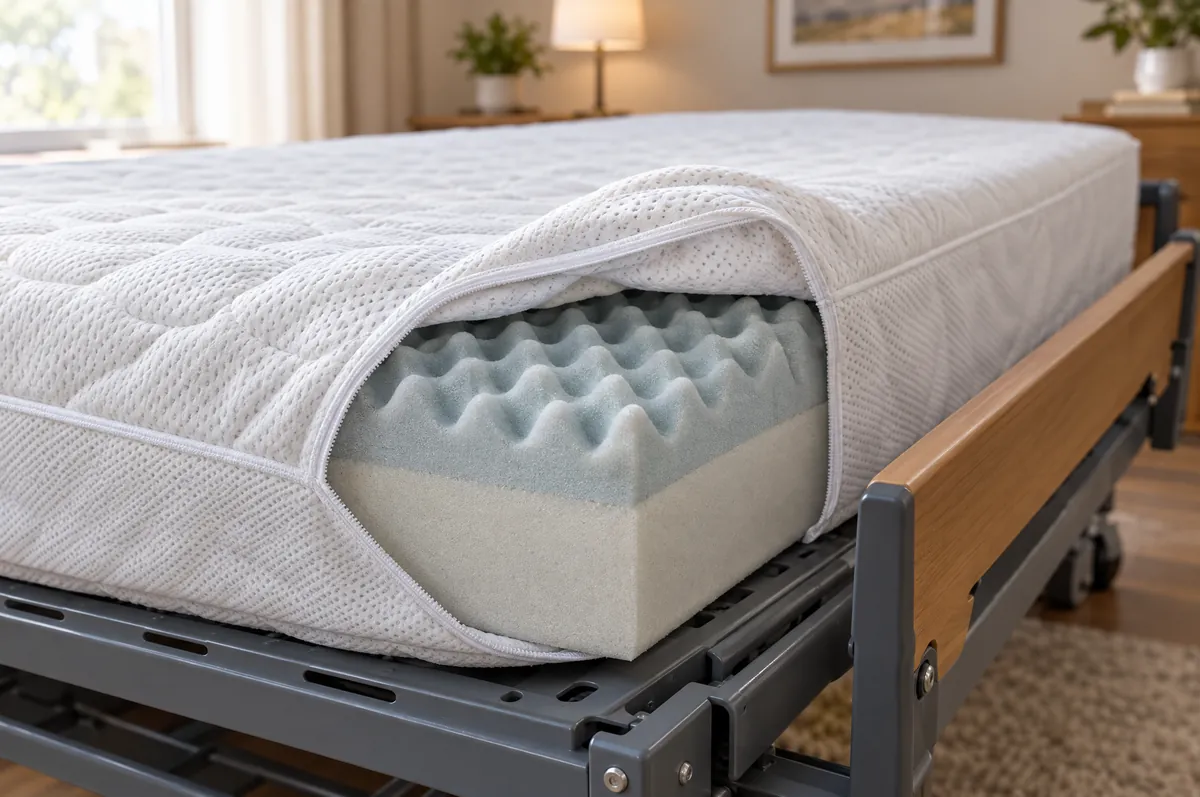
If a nurse, doctor, or therapist has mentioned a “low air loss mattress,” this page explains what that is, how it compares with other options, and what to check before you rent or buy, including the wider sizes and higher ratings needed with a bariatric bed. It’s general information, not medical advice: whether someone needs a powered surface is a decision for their care team.
What a low air loss mattress is
A low air loss mattress is a powered air mattress. A pump or blower, usually hung on the footboard, pushes air into a set of cells that make up the mattress. In a low air loss design, the cells are kept at a fairly low, even pressure while air moves through the surface. Makers describe the goal as spreading pressure across the body and helping manage heat and moisture where the skin meets the mattress. Prius, for example, says its MOXI Bari Select Air “helps manage microclimate of skin and improve moisture dissipation.”
Low air loss vs alternating pressure vs foam
Foam and gel mattresses are non-powered; alternating pressure mattresses inflate and deflate rows of cells in a cycle; low air loss mattresses keep cells at a low, even pressure while air circulates. Medicare bills both powered types as E0277.
| Surface | How it works | Power needed | Medicare group and code |
|---|---|---|---|
| Foam or gel mattress | Non-powered; spreads pressure through the material | No | Group 1 (for example E0184, E0196) |
| Alternating pressure | Rows of air cells inflate and deflate in a cycle, so pressure points shift over time | Yes | Group 2, E0277 |
| Low air loss | Cells stay at a low, even pressure while air circulates through the surface | Yes | Group 2, E0277 |
| Combination systems | Switch between alternating pressure and low air loss, often with extra modes | Yes | Group 2, E0277 |
Medicare’s coding article says alternating pressure and low air loss mattresses are both billed as E0277, a “powered pressure reducing mattress.” To qualify for that code, a mattress must have a pump that inflates and deflates the cells in sequence or keeps a low pressure throughout, inflated cells at least 5 inches high, enough lift to prevent “bottoming out,” a surface designed to reduce friction and shear, and the ability to sit directly on a hospital bed frame (CMS policy article A52490).
For an overview of every mattress type, see our hospital bed mattress guide.
Bariatric mattresses: sizes and ratings
Bariatric air mattresses come 42 to 60 inches wide, and the examples we checked list weight limits up to 750 or 1,000 lb. Match the mattress to the bed’s exact width and weight rating.
A bariatric bed needs a mattress that matches its width and weight rating. Examples from makers’ published specs (checked October 9, 2026):
| Mattress | Type | Widths | Thickness | Published weight limit |
|---|---|---|---|---|
| Prius MOXI Bari Select Air | Low air loss (“true” low air loss) | 42, 48; custom 54, 60 × 80 in. (84 with foot pillow) | 8 in. | 1,000 lb user weight |
| Drive Med-Aire Plus 10″ Bariatric | Alternating pressure and low air loss | 42, 48, 54, 60 × 80 in. | 10 in. | Varies by width; check the spec sheet |
| Transfer Master Geo-Mattress Atlas | Bariatric therapeutic mattress with a 2-inch topper and an air layer, per the maker | Sized to Transfer Master’s heavy-duty beds | See maker | Up to 750 lb |
Medicare doesn’t have separate bariatric codes for support surfaces. Its policy says heavy-duty and bariatric versions are included in the regular codes, such as E0277 (CMS policy article A52490).
What Medicare covers
Medicare covers a powered low air loss or alternating pressure mattress (Group 2, E0277) only under specific pressure-ulcer criteria, such as large or multiple stage 3 or 4 ulcers on the trunk or pelvis.
Medicare sorts pressure-reducing surfaces into groups with different coverage rules:
- Group 1 (pressure pads, mattress overlays, and non-powered mattresses) has the broadest criteria, such as being completely unable to change position without help, or having limited mobility or a pressure ulcer on the trunk or pelvis along with other risk factors (LCD L33830).
- Group 2 (powered mattresses such as low air loss and alternating pressure) is covered when the person meets one of three criteria: multiple stage 2 pressure ulcers on the trunk or pelvis that haven’t improved over the past month on a comprehensive treatment program that includes a Group 1 surface; large or multiple stage 3 or 4 ulcers on the trunk or pelvis; or a flap or skin graft for such an ulcer within the past 60 days, after being on a Group 2 or 3 surface just before discharge from a hospital or nursing facility in the past 30 days (LCD L33642). A care plan from the treating practitioner or home care nurse is expected.
In October 2026, Medicare’s approved monthly rental for an E0277 mattress ranged from $117.11 to $563.60 across the states (CMS fee schedule). Talk to the care team and a Medicare-enrolled supplier about whether the criteria are met. More in our Medicare guide.
Safety: what changes with an air mattress
Air mattresses behave differently from foam: they sit higher relative to the rails, can form gaps as they compress, have softer edges, and depend on power. Plan the setup for that:
- Thicker mattress, relatively lower rails. An 8- or 10-inch air mattress sits higher than a typical 6-inch foam mattress, so the rails stand less far above the sleeping surface. Ask whether taller rails or rail extensions are needed.
- Gaps. The FDA warns that gaps can form when a mattress compresses, and specifically mentions air mattresses (FDA). Check the gaps between the mattress, rails, and headboard with the mattress inflated and the person in bed.
- Soft edges. Sitting on the edge of an air mattress can feel less stable. Many systems have a firm or max-inflate mode for care and transfers; Prius says its firm mode “facilitates nursing care during dressing changes and patient repositioning,” and Drive lists an Auto-Firm feature.
- Power cuts. Ask what happens if the power goes out and for how long. Drive says its Med-Aire Plus bariatric cells provide up to 24 hours of power-outage protection.
- CPR. Look for a quick-deflate (CPR) valve. Drive lists one on the Med-Aire Plus.
- The cover. The FDA advises checking hospital mattress covers regularly for damage, because a worn cover can let fluids into the mattress (FDA).
Read more in hospital bed safety.
How to choose
Start with the care team’s recommendation, then match the mattress to the bed’s width and length, check its weight limit, and compare modes, alarms, and service.
- Ask the care team which surface they recommend, and why.
- Match the bed exactly: width, length, and whether the bed expands. A bariatric bed needs a bariatric-width mattress.
- Check the weight limit of the mattress, not only the bed, and count the mattress weight against the bed’s safe working load. See bariatric bed weight limits.
- Compare the modes: alternating pressure, low air loss, or both; static and firm modes for care.
- Ask about alarms for low pressure or power failure, and how loud the pump is at night.
- Plan for sheets: deep air mattresses need sheets with a deeper pocket. Follow the maker’s instructions on sheets, pads, and anything else placed on top.
- Ask about rental vs purchase and who services the pump.
What they cost
Published retail prices we saw in October 2026 for home alternating-pressure and low-air-loss systems ran from about $1,500 to about $5,000, with bariatric widths and multi-mode systems toward the top of that range. Rental is common for short-term needs. Prices change often and many makers don’t publish them, so check current pricing and ask what’s included (pump, cover, and warranty).
Not sure which bed and mattress combination fits? Read our bariatric bed guide or request a quote.
How we researched this guide
Coverage and coding come from CMS (LCD L33642, policy article A52490, LCD L33830) and amounts from CMS’s October 2026 fee schedule. Mattress specs come from Prius Healthcare, Drive, and Transfer Master product pages, and safety notes from the FDA, all checked October 9, 2026. Prices are from published listings at online retailers. We did not test these mattresses. See how we evaluate.