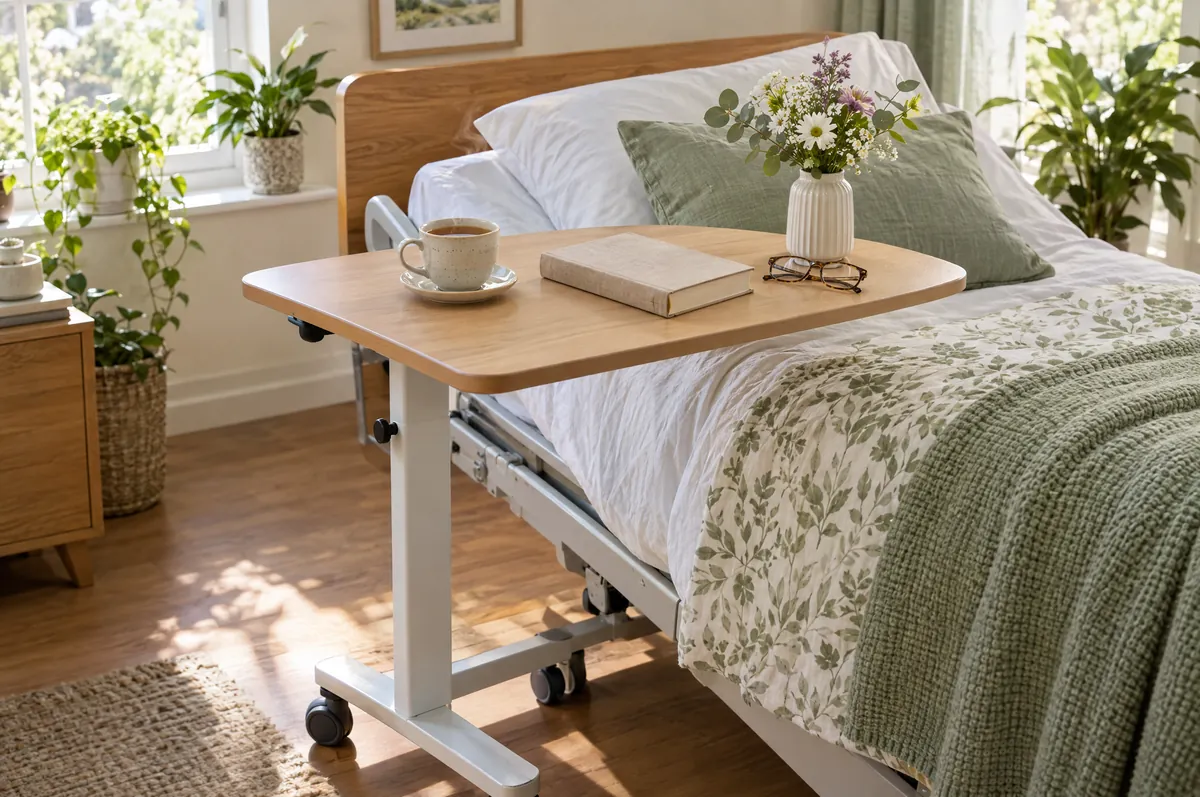
An overbed table is one of the most used pieces of equipment in a home care bedroom. It holds meals, water, medicines, glasses, a phone or tablet, and the things that make long days in bed easier. A table that fits rolls in smoothly and sits just above the lap. One that doesn’t fit hits the bed frame, won’t go high enough when the head of the bed is up, or wobbles every time someone touches it. This guide covers the measurements to take, the main design choices, and how to use one safely.
Overbed table, bed tray, or bedside table?
| Option | What it is | Best for | Limits |
|---|---|---|---|
| Overbed table | Rolling table with a base that slides under the bed and a top that reaches over the person | Meals and activities in bed, especially in a hospital bed that raises the head | Must fit the bed’s height and under-bed clearance |
| Lap or bed tray | Tray with short legs that rests on the mattress over the lap | Occasional meals for someone who sits up well | Can tip on a soft or air mattress; sits on the legs |
| Bedside table or nightstand | Fixed table beside the bed | Keeping things within reach at all times | Doesn’t reach over the lap |
Many households use both an overbed table and a bedside table: the overbed table for meals and activities, the bedside table so essentials stay within reach when the overbed table is rolled away.
Measure before you buy
Take these measurements with the bed and mattress the person will actually use:
- Top of the mattress at meal height. Raise the bed to the height you’ll use for meals and raise the head of the bed. Measure from the floor to the top of the mattress where the person sits. The table needs to rise above this, plus room for their lap and legs. A hospital bed’s height changes, so also note the height you’ll use for care.
- Under-bed clearance at the side. Measure from the floor to the lowest part of the bed frame along the side where the base will slide, and how far under the bed the base needs to go. Look for motors, cross-bars, wheels, brake pedals, side panels, or under-bed lights in the way.
- Mattress thickness. Air mattresses and toppers raise the sleeping surface. Include them in the first measurement.
- Floor space beside the bed. The base and column take up space where the caregiver works and where a walker or wheelchair may go.
- Chairs. If the table will also serve a recliner or lift chair, measure the clearance under the front of the chair and the seat height.
Then compare with the table’s published height range, base height, base length, and width. If the seller doesn’t publish base dimensions, ask before you buy.
Our hospital bed sizes guide explains how bed heights are measured, and why the top-of-mattress height matters more than the deck height.
Base shapes: which one fits
| Base | What it looks like | Good for | Watch out for |
|---|---|---|---|
| C-shaped or offset base | One column on one side; the base slides under the bed from that side | Standard hospital beds; keeping the other side of the bed open | Check the base length reaches far enough under the bed |
| H-base | Two parallel legs joined by a cross-bar | Steadiness, beds with open floor space underneath | Needs the most clearance under the bed |
| U-base | Legs that wrap around something on the floor | Recliners, wheelchairs, beds with parts near the floor | Check the opening width against the chair or bed |
| Low-profile base | Very low legs | Low beds and low chairs | Check the table’s lowest and highest heights still suit the bed |
Low beds and furniture-style beds need extra care. Very low beds can leave little space under the frame. Furniture-style beds may have upholstered side rails, skirts, or panels that reach close to the floor. See low hospital beds and hospital beds that look like regular beds for the beds themselves, and check under-bed clearance with the bed maker or seller.
Height adjustment, tops, and wheels
Height adjustment. Tables are raised and lowered with a spring-assisted lever, a crank, or a knob and pin. A lever that works with one hand is easiest for the person in bed. Make sure the table’s full range covers both the bed at meal height and any chair you’ll use.
Tabletop size. A larger top holds a full meal tray, but it’s harder to move around and can crowd a small room. Check the top’s published weight limit.
Tilt tops and split tops. A tilting top helps with reading or using a tablet. Look for a raised edge or ledge that stops things from sliding off. A split top has a small section that stays level for a drink while the main section tilts.
Edges and surface. Rounded edges are kinder to fragile skin. A wipe-clean surface is easier to keep hygienic; follow the maker’s cleaning instructions.
Wheels. Check how many wheels lock and how easy the locks are to reach. Larger wheels roll more easily over carpet and thresholds.
Using an overbed table safely
- It’s not a mobility aid. The table rolls and can tip if leaned on. Don’t use it to push up to sitting or standing.
- Move it out of the way for transfers and hands-on care, so no one trips on the base.
- Lock the wheels when the person is eating or using the table, if the table has locks.
- Keep hot drinks near the center of the top, away from the edge closest to the person.
- Watch cords from phones or tablets so they don’t trail across the bed or get caught as the bed moves.
- Lower the bed again after meals if the person should sleep at a low height. See hospital bed safety.
A therapist can suggest which side of the bed to place the table on so the person reaches with their stronger hand.
Paying for an overbed table
Medicare doesn’t pay for overbed tables. Its hospital bed policy lists them as not covered because they aren’t primarily medical in nature, even when Medicare covers the bed itself. Most families buy one privately; some borrow one from a medical equipment loan closet. See free and low-cost hospital beds for how to find loan closets, and what Medicare covers for the bed and covered accessories.
Overbed table checklist
- Highest table setting clears the lap with the bed at meal height and the head raised.
- Base fits under the bed frame without hitting motors, panels, or wheels.
- Lowest setting suits any recliner or lift chair you’ll use.
- Top holds what you need; tilt top has a ledge.
- Wheels lock and roll on your floors.
- Everyone knows not to lean on it.
More ideas for setting up the room, including other useful accessories, are in setting up a hospital bed at home and the printable hospital bed checklist.